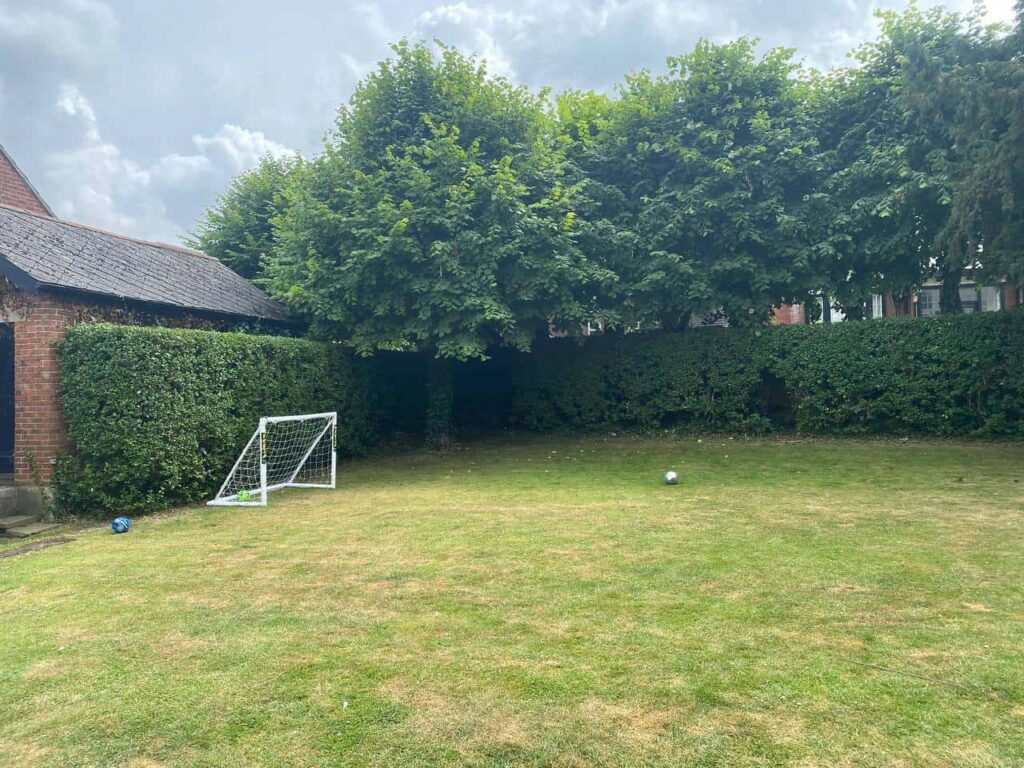
An overgrown tree does not automatically need to be removed. In many cases, carefully selected tree surgery can bring excessive growth under control while retaining the tree’s natural form, character and contribution to the garden. The important question is not simply how much growth can be removed, but which type of work is appropriate for the individual tree.
For homeowners in Newmarket, Suffolk, the right approach will depend on factors such as the tree’s size, species, condition, structure and position. Crown reduction, crown thinning, pruning and removal of specific branches can all have different purposes, which is why professional assessment should come before deciding how an overgrown tree should be managed.
Why Do Trees Become Difficult to Manage?
Trees naturally continue developing as they mature. In a spacious setting, increasing height and canopy spread may cause few difficulties. Within a residential garden, however, the available space is usually much more limited.
Over time, branches may begin to:
- Extend too far across the garden
- Grow close to buildings or other features
- Overhang paths or driveways
- Reduce useful space beneath the canopy
- Create excessive shading
- Interfere with neighbouring vegetation
- Become crowded within the crown
The solution should respond to the particular problem rather than simply reducing the tree indiscriminately.
Crown Reduction for an Oversized Canopy
Crown reduction is often considered when a tree’s overall canopy has become too large for its surroundings.
The process involves carefully reducing the height and spread of the crown while retaining an appropriate natural framework. Rather than cutting branches back randomly, suitable pruning points are selected to create a balanced result.
Crown reduction may be appropriate where a tree has become excessively dominant within a garden or where its branches are extending significantly beyond the desired area.
When performed correctly, the aim is to make the tree more manageable without unnecessarily compromising its natural shape.
Crown Reduction Is Different from Simply Cutting the Top Off
An important distinction should be made between professional crown reduction and indiscriminate topping.
Removing large sections without considering branch structure can leave an unnatural shape and may encourage undesirable regrowth. Good tree surgery considers how the tree is likely to respond after pruning.
Professional crown reduction focuses on proportion and suitable pruning points. The objective is controlled management rather than simply making the tree as small as possible.
Crown Thinning for a Dense Tree
Sometimes the overall dimensions of a tree are acceptable, but its crown has become excessively dense.
Crown thinning involves selectively removing appropriate branches from throughout the canopy without necessarily making the tree substantially smaller.
This can help create a more balanced crown while retaining the tree’s overall shape.
It may be considered where there is:
- Excessive internal branch density
- Crowded growth
- Crossing branches
- A need for selective canopy management
Crown thinning and crown reduction have different purposes, so deciding between them depends on what is actually causing the problem.
Selective Pruning May Be All That Is Needed
Not every overgrown tree requires work across the entire crown.
Sometimes only a small number of branches are creating difficulties. One limb might extend towards a building, another may hang over a frequently used area, or individual branches may have developed awkwardly.
Selective pruning can address these specific concerns while leaving the majority of the canopy unchanged.
This can be a particularly appropriate approach where the tree remains well proportioned overall but has developed localised unwanted growth.
Crown Lifting Can Improve Space Beneath a Tree
An overgrown tree can sometimes feel intrusive because its lower branches occupy too much usable space.
Crown lifting involves carefully removing or reducing selected lower branches to increase clearance beneath the canopy.
Depending on the individual tree and setting, this can help improve access around:
- Garden paths
- Driveways
- Lawns
- Seating areas
- Other regularly used spaces
Importantly, crown lifting does not necessarily reduce the overall height of the tree. Its purpose is to manage lower growth and improve clearance.
Dead and Damaged Branches Need Separate Attention
An overgrown canopy can sometimes make it difficult to notice dead, damaged or deteriorating branches.
These should be considered separately from general size management. Removing unsuitable branches can form part of a wider tree surgery programme where necessary.
A professional inspection allows the condition of individual branches to be considered alongside the overall shape and density of the crown.
This means the work can address both excessive growth and specific structural concerns at the same time.
What If the Tree Is Blocking Too Much Light?
Large trees can create considerable shade, but reducing a tree purely to increase light requires careful judgement.
Removing excessive growth in one operation is not necessarily the best approach. Depending on the tree, selective pruning, crown thinning or an appropriate crown reduction may improve the relationship between the canopy and surrounding garden.
The aim should be to achieve a sensible balance rather than attempting to remove as much foliage as possible.
Trees depend on their crowns, so pruning needs to take their continued health and development into account.
Tree Species Makes a Difference
Different tree species respond differently to pruning.
Some tolerate particular forms of management well, while others require a more conservative approach. Growth patterns, branch structure, age and condition can also influence what work is appropriate.
This is one reason there is no universal answer to the question of how an overgrown tree should be reduced.
Two trees of a similar size may require completely different approaches depending on their characteristics.
The Age and Condition of the Tree Matter
A mature tree cannot necessarily be managed in exactly the same way as a younger specimen.
Older trees may have established structures that require particularly careful consideration. Removing excessive amounts of growth can significantly alter the balance and appearance of the crown.
Before recommending work, a tree surgeon can assess factors such as:
- Overall vitality
- Branch structure
- Existing defects
- Previous pruning
- Canopy density
- Distribution of weight
- Amount of suitable growth available for pruning
This information helps determine how much intervention is appropriate.
Previous Poor Pruning Can Complicate Matters
Some overgrown trees have already undergone significant pruning in the past.
Previous cuts may have encouraged dense regrowth, altered the natural branch structure or created areas requiring careful future management.
In these circumstances, simply repeating the previous approach may not produce the best result.
Professional tree surgery can consider how the tree has responded to earlier work and develop a more appropriate management strategy.
Should an Overgrown Tree Be Reduced in Stages?
In some situations, gradual management can be preferable to attempting a major transformation in one visit.
Where a tree has become substantially overgrown, staged pruning may allow its size and structure to be managed more carefully over time.
Whether this is appropriate depends entirely on the individual tree. The key principle is that tree surgery should respond to how much work the tree can reasonably tolerate rather than simply how much reduction the surrounding garden would ideally accommodate.
When Might Tree Removal Be Considered?
Removal is not normally the first conclusion simply because a tree has become large.
If the tree is healthy and can be appropriately managed through professional pruning, retaining it may be entirely practical.
There are circumstances, however, where pruning alone may not provide a suitable long-term solution. The tree’s condition, position, structure and relationship with its surroundings all need to be considered.
A professional assessment can determine whether ongoing management is realistic or whether a different approach should be considered.
Why Professional Assessment Is Important
It can be difficult to judge an overgrown tree simply by looking at its overall size.
A tree surgeon considers much more than height and spread. The assessment looks at the tree as a living structure and considers how different pruning options may affect its future development.
A suitable approach may involve:
- Assessing the tree’s condition.
- Identifying the growth causing the problem.
- Examining the crown and branch structure.
- Determining which type of pruning is appropriate.
- Selecting suitable pruning points.
- Retaining a balanced natural form.
- Considering how the tree is likely to respond afterwards.
This provides a much more controlled result than simply cutting back whichever branches appear too long.
Good Tree Surgery Should Still Look Natural
One sign of well-planned tree surgery is that the finished tree should retain a coherent form.
The objective is not to leave a visibly chopped or dramatically altered canopy. Where possible, pruning should complement the tree’s existing structure.
A successfully managed tree may be smaller, lighter or provide better clearance, but it should still look like the same tree.
This is particularly important for mature specimens that contribute significantly to the character of a garden.
Professional Tree Surgery in Newmarket
At Newmarket Tree Surgeons, we provide professional tree surgery services throughout Newmarket, Suffolk. When a tree has become overgrown, our approach begins with understanding exactly what is causing the difficulty and assessing the condition and structure of the tree.
Depending on the circumstances, appropriate work may involve crown reduction, crown thinning, crown lifting or selective pruning. Rather than applying the same solution to every tree, the aim is to choose an approach suited to the individual specimen and its surroundings.
Careful tree surgery can often make a substantial difference to an overgrown garden while allowing established trees to remain an attractive and manageable part of the property.
Conclusion
The best type of tree surgery for an overgrown tree depends on why the tree has become difficult to manage. Crown reduction may help where the overall canopy has become too large, crown thinning can address excessive density, crown lifting can improve clearance beneath lower branches, and selective pruning may resolve problems caused by individual limbs.
The important point is that an overgrown tree should not simply be cut back as heavily as possible. Species, age, condition, branch structure and future growth all need to be considered before deciding on the appropriate work.
For homeowners in Newmarket, Suffolk, Newmarket Tree Surgeons can assess overgrown trees and recommend a suitable approach based on their condition and surroundings. If a tree is becoming too large or difficult to manage, contact our team to arrange a professional assessment and find out how appropriate tree surgery could bring it back under control.
Call us on: 01638 591 692
Click here to find out more about Newmarket Tree Surgeons
Click here to complete our contact form and see how we can help with your tree needs.